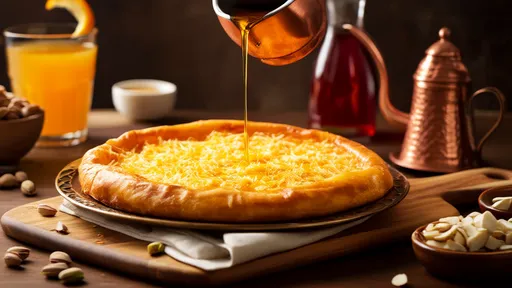
In the bustling markets of the Middle East, the aroma of freshly baked pastries often leads eager patrons to one particular delicacy: kunafa. This beloved dessert, with its golden, crispy exterior and rich, cheesy interior, has been a staple of regional cuisine for centuries. While its preparation may seem straightforward to the uninitiated, true mastery of kunafa lies in two critical, often debated elements: the selection of cheese and the precise timing of syrup soaking. These factors can elevate the dish from merely good to utterly transcendent, making the difference between a forgettable treat and a memorable culinary experience.
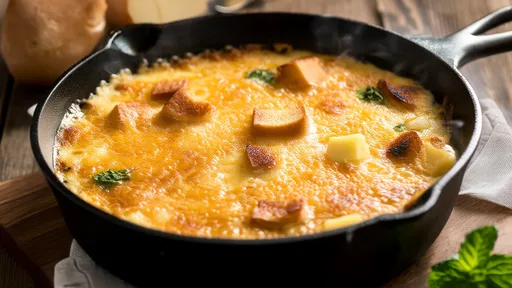
The heart of any great kunafa is, without question, its cheese. Unlike Western desserts that often rely on cream or custard, kunafa derives its distinctive character from the stretchy, savory quality of the cheese nestled within its shredded pastry layers. The choice of cheese is not merely a matter of preference but a decision deeply rooted in tradition, texture, and taste. Across the Levant, variations abound, each region boasting its own signature blend that reflects local tastes and ingredient availability.
Among the most commonly used cheeses is Nabulsi, a brined white cheese originating from the Palestinian city of Nablus. This cheese is prized for its excellent melting properties and its ability to maintain a pleasant chewiness without becoming overly greasy. However, Nabulsi is notoriously salty, a characteristic that requires careful preparation. Before being used in kunafa, it must be desalinated through soaking or boiling to balance its flavor against the sweetness of the syrup. When properly treated, it provides a perfect salty counterpoint that enhances the overall sweetness of the dessert.
Another popular choice is akawi, a semi-hard cheese common in Palestinian, Jordanian, and Syrian cuisine. Like Nabulsi, it is stored in brine and possesses a notable saltiness that must be mitigated. Akawi is valued for its mild flavor and superb stretch, contributing to that iconic stringy pull that makes eating kunafa such a tactile pleasure. In some modern interpretations, cooks blend akawi with a touch of mozzarella to amplify this elasticity, creating a hybrid that honors tradition while embracing contemporary convenience.
In Egypt and parts of the Gulf, a fresh, unsalted cheese called areesh or qishta is often the star. This cheese is much milder and softer, resulting in a creamier, less elastic filling. It offers a different textural experience, one that is less about the pull and more about a lush, almost custard-like melt-in-the-mouth sensation. This variation highlights the diversity within the kunafa family, showing how a single dish can adapt to local palates and ingredients.
Beyond these traditional options, some contemporary chefs experiment with ricotta or even sweetened cream cheeses, particularly in versions aimed at Western audiences or those preferring a less salty profile. However, purists often argue that these substitutes, while delicious in their own right, lack the authentic bite and complexity that the brined cheeses provide. The debate over cheese is, therefore, not just technical but philosophical, touching on questions of authenticity, innovation, and the very soul of the dessert.
Yet, selecting the perfect cheese is only half the battle. The other crucial element, arguably just as important, is the management of the sugar syrup, or qater. This syrup, typically made from sugar, water, and a splash of lemon juice or rose water, is what gives kunafa its characteristic sweetness and moisture. However, its application is a delicate art, fraught with potential pitfalls. Pour it too early, and the pastry turns soggy, losing its coveted crispness. Apply it too late, and the dessert can be dry and harsh, with the syrup failing to permeate the layers properly.
The timing of the syrup soak is a moment of high drama in the kunafa-making process. The general rule, passed down through generations, is to pour the syrup over the kunafa immediately after it emerges from the oven, while it is still piping hot. The heat helps the pastry absorb the syrup more effectively, allowing it to seep into every nook and cranny without completely saturating and collapsing the structure. The sound of the sizzle as the syrup hits the hot tray is, to many, the sound of success.
However, nuances exist. Some artisans advocate for letting the kunafa cool for a few minutes before adding the syrup, arguing that this brief rest allows the pastry to set slightly, preventing it from becoming a mushy mess. Others insist that the syrup itself should be warm, but not hot, when applied to avoid cooking the sugar further and altering its flavor. The temperature of both components—the kunafa and the syrup—must be in perfect harmony to achieve the ideal texture.
The composition of the syrup also plays a role in timing. A thicker syrup, perhaps reduced longer or made with a higher sugar ratio, might need to be applied with more caution as it can lead to a cloying sweetness and a heavier, wetter final product. A lighter syrup, infused with citrus or floral notes, might be more forgiving. The goal is always a dessert that is moist and sweet but still retains a satisfying crunch in its top layers, a textural contrast that is central to its appeal.
Mastering the interplay between cheese and syrup is what separates the novice from the expert. The cheese provides the foundational flavor and texture, while the syrup adds the necessary sweetness and moisture. When these two elements are in balance, the result is a dessert that is complex and harmonious: salty yet sweet, crispy yet soft, rich yet light. It is a testament to the sophistication of Middle Eastern pastry arts, where simplicity belies deep technical skill.
For the home cook attempting kunafa for the first time, the journey can be daunting. Advice abounds, often contradictory. Some sources swear by a specific cheese blend; others are militant about syrup temperature. The truth is that kunafa, like all great dishes, has room for variation. The best approach is to understand the principles—why certain cheeses behave the way they do, how heat affects absorption—and then to practice, taste, and adjust. Personal preference will always be the ultimate guide.
In professional kitchens, the preparation is often a closely guarded secret, a recipe refined over years. The cheese is meticulously prepared, sometimes soaked for hours and then hand-pulled to achieve the perfect consistency. The syrup is simmered to a precise temperature, tested with a sugar thermometer or by the drop method to ensure the right viscosity. The baking is watched like a hawk, the pastry rotated to guarantee even browning. And the final pour is timed to the second, a culmination of careful planning and instinct.
Ultimately, kunafa is more than just a dessert; it is a cultural icon, a symbol of hospitality and celebration. It is served during Ramadan to break the fast, at weddings to sweeten the couple’s future, and at family gatherings to express love and togetherness. Its preparation is an act of care, and its consumption a shared joy. The choices made in its creation—the selection of cheese, the timing of the syrup—are therefore imbued with significance, reflecting a desire to offer not just food, but an experience.
As global interest in Middle Eastern cuisine continues to grow, kunafa is finding new audiences far from its origins. From trendy cafes in New York to pop-up stalls in London, interpretations of the classic are emerging. Some stay true to tradition, while others take bold liberties, incorporating ingredients like chocolate or fruit. Yet, at its core, the success of any kunafa, traditional or modern, still hinges on those two critical factors: the right cheese, and the perfect moment for the syrup. Get these right, and you have a dessert that resonates across cultures and generations, a true masterpiece of the pastry world.
By /Aug 20, 2025

By /Aug 20, 2025
By /Aug 20, 2025
By /Aug 20, 2025

By /Aug 20, 2025
By /Aug 20, 2025
By /Aug 20, 2025
By /Aug 20, 2025

By /Aug 20, 2025
By /Aug 20, 2025
By /Aug 20, 2025
By /Aug 20, 2025
By /Aug 20, 2025
By /Aug 20, 2025

By /Aug 20, 2025

By /Aug 20, 2025
By /Aug 20, 2025

By /Aug 20, 2025
By /Aug 20, 2025
By /Aug 20, 2025
