There is a particular alchemy to the perfect Portuguese custard tart, a delicate balance of texture, temperature, and taste that transcends its seemingly simple ingredients. At the heart of this experience lies a beautiful, almost poetic duality: the dark, bitter-sweet punctuation of the caramelized top against the warm, woody embrace of cinnamon. This is not merely a garnish; it is the soul of the pastry, a story told in two distinct yet harmonious flavors.
The journey of the Pastéis de Nata begins not in a patisserie, but within the hallowed walls of monasteries and convents. In the 13th century, monastic communities used egg whites to starch their habits and vestments, leaving them with a colossal surplus of egg yolks. Resourcefulness being a virtue, these yolks were transformed into a wealth of rich, egg-based sweets and pastries. The specific recipe for these custard tarts is often attributed to the monks of the Jerónimos Monastery in the parish of Santa Maria de Belém, Lisbon. The tarts were known as Pastéis de Belém, a name still proudly used by the descendants of the original recipe's purchasers. Their creation was a practical solution that, through centuries of refinement, became a national treasure.
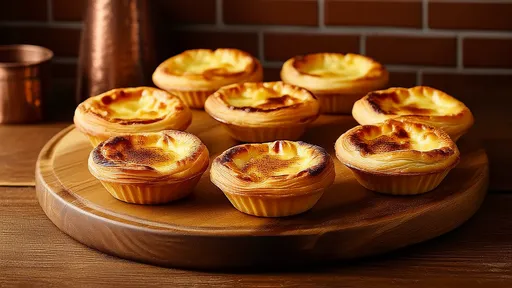
The magic of the tart is unlocked in the final, fiery moments of its creation. The custard, a carefully guarded blend of cream, sugar, egg yolks, and sometimes a hint of lemon zest or vanilla, is spooned into delicate cups of puff pastry. These are then subjected to an inferno. The ovens are blisteringly hot, often exceeding 300°C (570°F). This is not baking; it is a culinary blast furnace. The intense, direct heat performs a kind of culinary sorcery. The sugars in the custard don't just brown; they undergo a rapid, violent caramelization. They combust and carbonize in tiny, random pockets, creating a landscape of black and dark brown blisters and spots. This is the coveted char, the scorch, the burn that defines a truly great Pastél de Nata.
This characteristic blistering is far more than an aesthetic choice. It is the primary source of the tart's complex flavor profile. Each of those dark spots is a concentrated burst of bitterness, a counterpoint to the profound sweetness of the custard beneath. It introduces a smoky, almost toffee-like depth that cuts through the richness, preventing the dessert from becoming cloying. The texture is equally crucial. The caramelized top offers a slight, satisfying resistance—a crisp, almost glass-like shatter—before giving way to the impossibly smooth and creamy custard. This contrast between the crackle of the top and the silken interior is a fundamental part of the eating experience, a textural symphony in a single bite.
Then comes the cinnamon. Presented always on the side, either in a shaker or a small packet, its application is a personal ritual for the consumer. The fine, ruddy-brown powder is dusted over the top moments before eating. The choice of cinnamon is not incidental. It is almost invariably Ceylon cinnamon (Cinnamomum verum), known as "true cinnamon." This variety is subtler and more aromatic than its stronger, more common cousin, Cassia. Ceylon cinnamon possesses a sweet, woody warmth with citrusy undertones, lacking the harsh, overpowering heat that could dominate the delicate pastry.
The pairing is a masterpiece of sensory design. The cinnamon does not sit idly on top; it interacts. Its fine particles catch in the craggy, volcanic landscape of the caramelized crust. The warmth of the spice, both in flavor and sensation, melds with the residual heat of the freshly baked tart, releasing its essential oils and aroma. This creates an olfactory prelude to the first bite. But its true genius is as a bridge. The warm, sweet, woody notes of the cinnamon act as a perfect mediator between the aggressive, bitter char of the crust and the lush, eggy sweetness of the custard. It smooths the transition, rounding out the sharp edges of the caramelization and complementing the vanilla notes in the filling. It brings a comforting, earthy balance to the entire ensemble.
To eat a Pastél de Nata without its cinnamon is to hear only half of a conversation. You experience the brilliant contrast of textures and the push-pull of sweet and bitter custard, but you miss the unifying element that ties it all together. The cinnamon provides a grounding, aromatic warmth that makes the experience feel complete and whole. It is the final, essential seasoning that elevates the tart from a mere pastry to a cultural icon. It is a tradition that is as ingrained as the recipe itself, a small act of participation that connects the eater to centuries of Portuguese culinary history.
Beyond the borders of Portugal, the cinnamon shaker is often the first tradition to be lost or overlooked. Many cafes and bakeries abroad serve the tarts plain, perhaps with a dusting of icing sugar, misunderstanding the core components of its identity. The true aficionado knows to seek out, or request, that packet of cinnamon. It is the key that unlocks the full, intended spectrum of flavors. It transforms a delicious custard tart into an authentic Pastél de Nata experience.
Ultimately, the Portuguese custard tart is a lesson in balance. It is a study of how opposites attract and enhance one another. The blistering heat of the oven creates a beautiful imperfection in the char, which is then soothed by the ancient, comforting spice. It is a dessert of fire and earth, of crisp and cream, of bitter and sweet. The caramelized top and the dusting of cinnamon are not mere toppings; they are the yin and yang of the pastry, two inseparable forces that have, together, baked their way into the heart of a nation's cuisine and onto the world's stage.
By /Aug 20, 2025

By /Aug 20, 2025
By /Aug 20, 2025
By /Aug 20, 2025
By /Aug 20, 2025
By /Aug 20, 2025
By /Aug 20, 2025
By /Aug 20, 2025
By /Aug 20, 2025
By /Aug 20, 2025
By /Aug 20, 2025
By /Aug 20, 2025
By /Aug 20, 2025
By /Aug 20, 2025
By /Aug 20, 2025
By /Aug 20, 2025
By /Aug 20, 2025

By /Aug 20, 2025
By /Aug 20, 2025
By /Aug 20, 2025
