In the hushed, flour-dusted kitchens of French patisseries before dawn, a quiet revolution unfolds daily—not with words, but with butter and dough. The croissant, that iconic symbol of French culinary artistry, appears deceptively simple in its crescent form. Yet, its entire identity—the ethereal height, the honeycomb crumb, the symphony of crisp shatter and melting richness—hangs on a single, precise technical dance: the lamination. This process of folding butter into dough, creating hundreds of delicate, alternating layers, is the very heart of the craft. For generations, bakers have operated on received wisdom, often capping their folds at a traditional number. But a provocative question now permeates the top echelons of baking: is there a physical limit to how many layers one can create? Pushing the boundaries of this buttery architecture is not merely an academic exercise; it is a pursuit to fundamentally understand and redefine the limits of texture itself.
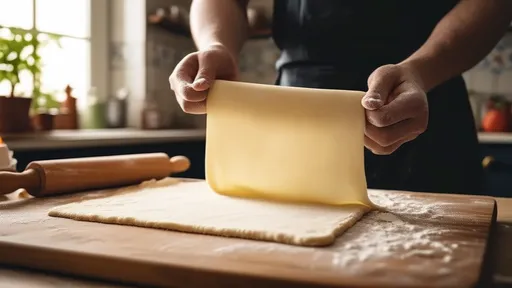
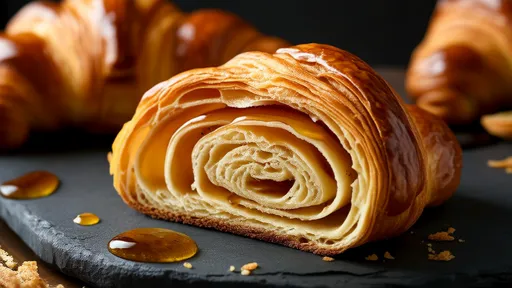
The foundational principle of lamination is a study in contrasts and containment. It begins with a lean, elastic dough, the détrempe, and a cold, malleable slab of high-butterfat beurre de tourage. The baker's initial goal is to envelop the butter completely within the dough, creating a sealed package, a beurrage. This package is then rolled out and folded, a process repeated multiple times. Each fold, whether a simple letter fold or the more complex book fold, multiplies the existing layers exponentially. The magic, however, happens in the oven. The water in the dough flashes into steam, pushing these paper-thin layers apart. Meanwhile, the butter melts, frying the dough from the inside and leaving its fat in the spaces it once occupied. The result is the airy, flaky structure we crave. The number of layers isn't just a count; it's the primary variable controlling the final texture—more layers typically mean a finer, more delicate, and more shattering crumb.
For decades, the golden standard in countless boulangeries has been three to four folds, resulting in a manageable 55 to 81 layers. This number wasn't plucked from thin air; it represents a pragmatic equilibrium. It produces a croissant with excellent volume, a clear, flaky separation, and a rich, buttery flavor. Crucially, it is a process that can be reliably executed by a skilled artisan working against the clock and the warming room temperature. The butter must remain cold and solid; if it softens and incorporates into the dough, the distinct layers merge, resulting in a brioche-like bread—a complete failure in the quest for flakiness. The traditional number, therefore, is as much about achieving perfection as it is about mitigating the risk of failure during a demanding manual process.
But what happens when we venture beyond this comfortable plateau? The pursuit of extreme lamination—pushing to 100, 200, or even hypothetically more layers—introduces a host of formidable physical and chemical challenges. The first and most immediate enemy is heat. Each pass through the sheeter or with the rolling pin generates friction, warming the butter. Performing more folds requires more rolling, exponentially increasing this thermal threat. The baker must work with inhuman speed or employ extended resting periods in a refrigeration unit, making the process incredibly time-intensive. The second adversary is mechanical stress. As the number of layers skyrockets, the individual strata become impossibly thin, often thinner than a sheet of paper. The structural integrity of both the dough and the butter is tested to its absolute limit. During rolling, these microscopic layers can easily tear, merge, or be compressed beyond recognition, undoing all the meticulous work.
The final, and perhaps most fascinating, barrier is a fundamental law of physics: the behavior of water vapor. The leavening in a croissant is almost entirely mechanical, driven by steam. For a successful oven spring, the steam must generate enough pressure to forcefully separate each layer. However, as layers multiply into the hundreds, they become so numerous and thin that the spaces between them are minuscule. The steam pressure required to inflate these micro-chambers is immense. Often, the force is insufficient, and the layers simply fail to lift, or they fuse together during baking. Conversely, if the pressure does build, it can find a weak point and burst outward violently, creating a blowout rather than a graceful rise. This creates a paradox: beyond a certain point, adding more layers can actually result in a denser, tougher pastry because the architecture can no longer be successfully inflated by its own internal steam.
A new wave of avant-garde bakers and food scientists, armed with temperature-controlled rooms, laser-guided sheeters, and a zeal for experimentation, are actively testing these limits. Their experiments are yielding groundbreaking insights. They are discovering that the relationship between layer count and quality is not linear but parabolic. There is a peak—a sweet spot of sublime texture—after which quality precipitously declines. This optimal point appears to be highly dependent on other factors: the protein content of the flour, the plasticity and melting point of the butter, and the precise baking temperature. Some modernists are achieving remarkable results with 128 or even 256 layers, but these are laboratory-perfect conditions, far removed from a bustling bakery. Their findings suggest a theoretical limit does exist, not as a fixed number, but as a shifting horizon defined by the interaction of their ingredients and technique.
So, does a universal, absolute limit exist? The answer is nuanced. There is no magic number at which a croissant spontaneously combusts or disintegrates. Rather, the limit is practical and qualitative. It is the point where the physical drawbacks—butter meltdown, structural failure, and inflation collapse—irrevocably outweigh any potential textural benefit. Pushing into the realm of extreme layers often sacrifices the very soul of the croissant. The interior crumb can become overly fine, almost cottony, losing its satisfying tear and yielding quality. The exterior, instead of being a complex landscape of shattering shards and crisp flakes, can become hard, brittle, and monolithic. The baker is ultimately chasing a ghost of perfection, adding complexity and effort for a return that diminishes and eventually becomes negative. The quest for the ultimate layer becomes a lesson in diminishing returns.
The journey to find the outer boundary of croissant lamination is far more than a technical obsession. It is a profound dialogue between tradition and innovation, between the artisan's hand and the laws of science. While the pursuit of 1000 layers may be a fantastical engineering challenge, it teaches us invaluable lessons about the material we work with. It forces a deeper appreciation for the classic techniques honed over centuries. The traditional 81-layer croissant is not a limitation of past skill; it is a testament to its genius—a perfect, hard-won balance of flavor, texture, and practicality. The limit, therefore, is not a barrier to creativity but a definition of form. It teaches us that in pastry, as in all art, true mastery lies not in relentless addition, but in understanding the beauty and necessity of constraints. The perfect croissant is not the one with the most layers, but the one where every single, buttery, paper-thin layer serves a perfect, harmonious purpose.
By /Aug 20, 2025

By /Aug 20, 2025
By /Aug 20, 2025
By /Aug 20, 2025
By /Aug 20, 2025
By /Aug 20, 2025
By /Aug 20, 2025

By /Aug 20, 2025
By /Aug 20, 2025
By /Aug 20, 2025
By /Aug 20, 2025
By /Aug 20, 2025

By /Aug 20, 2025
By /Aug 20, 2025

By /Aug 20, 2025

By /Aug 20, 2025
By /Aug 20, 2025

By /Aug 20, 2025
By /Aug 20, 2025

By /Aug 20, 2025
