In the rolling hills of Modena and Reggio Emilia, where the air carries the sweet scent of aging grapes, a culinary tradition centuries in the making unfolds in quiet attics and specialized acetaie. Here, in rows of diminishing barrels crafted from sundry woods, the magic of Aceto Balsamico Tradizionale transpires—a patient alchemy that transforms simple grape must into a complex, glossy elixir revered by chefs and gourmands worldwide. The journey from fruit to famed condiment is governed by time, evaporation, and a stringent regulatory system, with the final product’s age designation serving as the most direct indicator of its concentration and, consequently, its character.
The very soul of traditional balsamic vinegar lies in its reduction. The process begins with the cooking of freshly pressed juice—typically from Trebbiano or Lambrusco grapes—into a dense, sweet must. This cooked mosto cotto is then transferred into a battery, or series, of barrels. Each barrel is made from a different type of wood—such as oak, cherry, chestnut, mulberry, or juniper—imparting its own unique notes to the evolving vinegar. As the years pass, a portion of the liquid is transferred to a smaller barrel in the series, a practice known as rincalzo or rabocco. This is not merely a topping-up method; it is the engine of concentration. The lost volume is not replaced with water but with slightly younger vinegar from the preceding barrel, ensuring the perpetual intensification of flavor, sweetness, and viscosity.
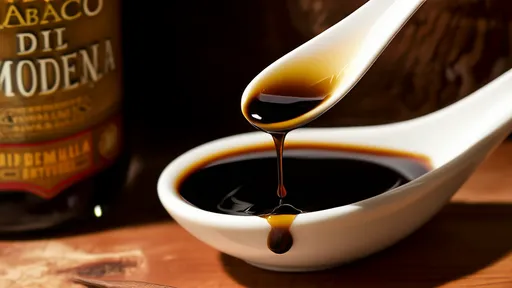
Evaporation is the silent, relentless artist at work. In the warm, dry lofts of Emilia-Romagna, a significant percentage of the vinegar’s water content slowly vanishes through the porous wood of the barrels each year. This natural concentration is what separates true tradizionale from its myriad commercial imitations. There is no shortcut; the density and syrupy consistency are earned solely through the passage of time. The older the vinegar becomes, the more liquid is lost, and the more profound the transformation. The result is a product so thick it coats the spoon, with an intricate balance of sweet and acidic notes that can include hints of wood, dried fruit, chocolate, and even balsamic’s namesake balsamic—or healing—qualities.
This intimate relationship between time and concentration is formally recognized and protected by the strict Denominazione di Origine Protetta (DOP) regulations. The consortiums for both Aceto Balsamico Tradizionale di Modena DOP and Aceto Balsamico Tradizionale di Reggio Emilia DOP mandate a minimum aging period. For the Affinato (or refined) grade, the vinegar must age for a minimum of 12 years. The liquid at this stage is already remarkably concentrated, possessing a deep brown color and a well-rounded flavor profile that is both tart and sweet. It is a versatile condiment, excellent on grilled meats, aged cheeses, and even strawberries.
The pinnacle of this artisanal craft is the Extra Vecchio (or extra old) designation. To earn this title, the vinegar must slumber in its wooden casks for a minimum of 25 years, though many producers age their finest batches for far longer—50, 80, or even over 100 years. The concentration achieved over such an epic timeline is staggering. The vinegar becomes almost impossibly dense, with a profoundly complex aroma and a flavor that unfolds in waves on the palate. It is a transcendent experience, typically reserved for drizzling over precious slivers of Parmigiano-Reggiano, ripe figs, or vanilla ice cream, or even sipped neat like a fine liquor after a meal. The age statement on the bottle is therefore a direct promise of this textural and flavorful intensity.
While the DOP tradizionale represents the apex, the more common Aceto Balsamico di Modena Indicazione Geografica Protetta (IGP) occupies a different space. This category allows for the addition of wine vinegar and caramel for color, and its aging requirements are far less rigorous. Consequently, its concentration levels are not guaranteed by a long, natural reduction process. An IGP vinegar might state it is invecchiato (aged) for a certain number of years, but this does not equate to the profound, evaporation-driven concentration of a DOP product. The texture is often thinner, and the flavor profile, while pleasant, lacks the breathtaking depth of its tradizionale cousin.
For the consumer, understanding this link between the age stamp and the physical property of concentration is the key to navigating the world of balsamic vinegar. A younger Affinato will pour more readily, while an Extra Vecchio will ooze slowly, clinging to the glass in a testament to its decades of patient refinement. This viscosity is the simplest, most visceral indicator of quality and aging. It is the physical manifestation of time itself, a density earned drop by evaporated drop over generations. When you see those years stated on a label, you are not just reading a number; you are being told a story of loss—of water vanished into the Italian air—and the glorious, flavorful gain that was left behind.
Ultimately, the age designation on a bottle of traditional balsamic vinegar is far more than a marketing term or a measure of time passed. It is a direct and reliable gauge of the liquid’s journey through concentration. It tells of summer heat and winter cold working upon the barrels, of the care of the acetaio who manages the rincalzo, and of the slow, beautiful sacrifice of volume for the sake of unparalleled flavor. To taste a well-aged tradizionale is to taste history itself, condensed into a single, perfect drop.

By /Aug 20, 2025

By /Aug 20, 2025
By /Aug 20, 2025

By /Aug 20, 2025

By /Aug 20, 2025
By /Aug 20, 2025
By /Aug 20, 2025

By /Aug 20, 2025
By /Aug 20, 2025

By /Aug 20, 2025
By /Aug 20, 2025

By /Aug 20, 2025
By /Aug 20, 2025

By /Aug 20, 2025

By /Aug 20, 2025

By /Aug 20, 2025

By /Aug 20, 2025

By /Aug 20, 2025
By /Aug 20, 2025

By /Aug 20, 2025
